
BLOG | Oak for Wineries
Oak Alternatives for Bulk Winemaking – Scaling Oak at High Volume
BLOG | Oak for Wineries Oak Alternatives for Bulk Winemaking – Scaling Oak at High Volume by Brandon Haas Published on 07/28/2026 ON THIS PAGE No headings found in this post. Become an oak expert today! $Shop Now Bulk winemaking — commercial wine production at volumes of 50,000 gallons and above — operates under constraints […]
by Brandon Haas
Published on 07/28/2026
ON THIS PAGE
Become an oak expert today!
- Shop Now
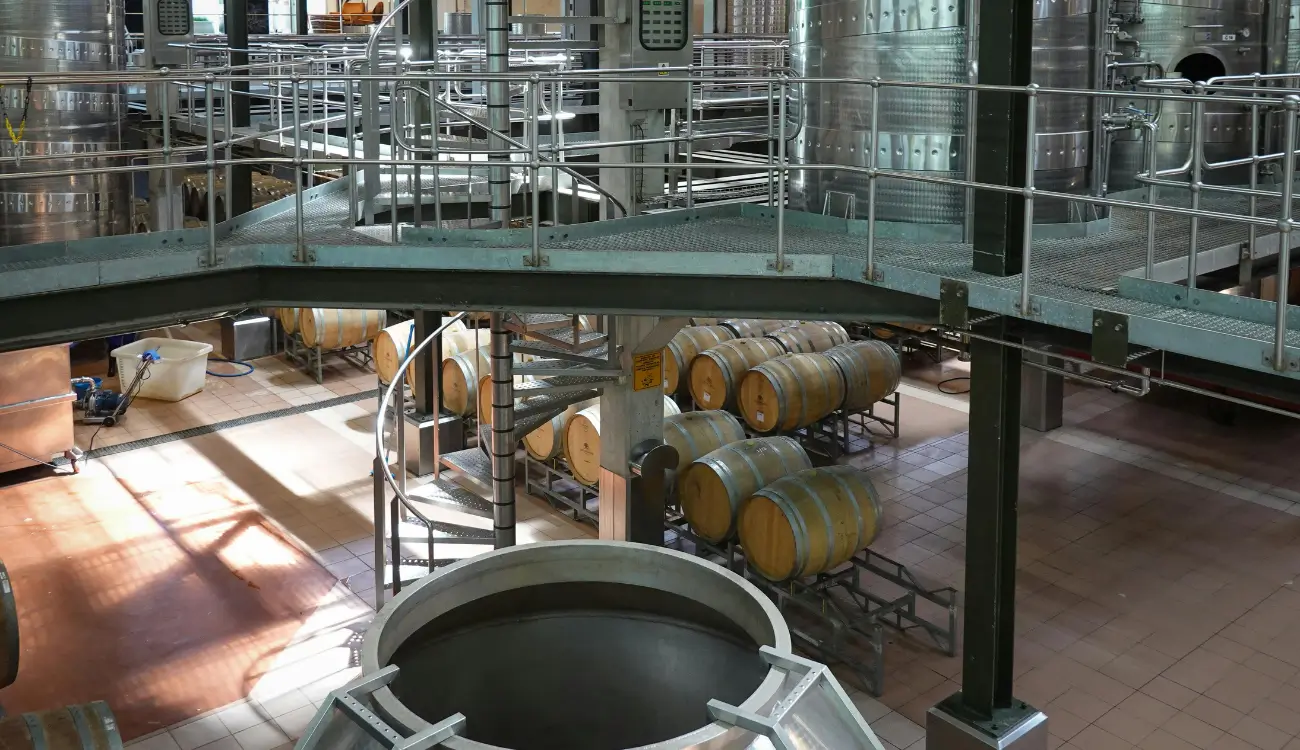
Bulk winemaking — commercial wine production at volumes of 50,000 gallons and above — operates under constraints that make barrel aging economically and logistically impractical for most of the production volume. Oak alternatives are not a compromise in this context. They are the standard tool, used by virtually every large commercial producer globally, and the quality of the best bulk wines today reflects decades of refinement in how they are applied.
This guide covers the specific considerations for designing and running oak programs in bulk winemaking environments — large tank sizes, multiple concurrent lots, high-volume ordering, and quality control at scale.
What Is Bulk Winemaking?
For the purposes of this guide, bulk winemaking refers to commercial wine production at volumes where individual lot sizes are typically 5,000–100,000 gallons or more. This includes:
– Large commercial wineries producing 500,000+ cases per year
– Custom crush and contract winemaking operations
– Bulk wine producers supplying private label and branded programs
– Cooperative wineries processing large grape volumes
At these scales, the operational and financial constraints of barrel programs are not a tradeoff — they are a disqualifier. 50,000 gallons in French oak barrels would require approximately 833 barrels at $1,100 each: $916,000 in barrel purchase alone, before storage, topping, maintenance, and labor. For most bulk winemaking operations, that capital commitment is neither practical nor justifiable relative to the quality and cost outcomes achievable with a well-designed oak alternative program.
Why Barrels Don’t Work at Bulk Scale
The constraints are structural, not stylistic.
Capital
At 50,000 gallons, a full French oak barrel program requires $900,000+ in barrel purchase in Year 1. At 200,000 gallons, it exceeds $3.5M. These are not costs that can be amortized sensibly against the price point of most bulk wine.
Space
833 barrels for 50,000 gallons requires approximately 8,300 square feet of dedicated barrel cellar — humidity-controlled, rack-equipped, and climate-managed. For a facility already operating large-format tanks, that space does not exist and would cost millions to build.
Labor
The topping, washing, sulfuring, and maintenance overhead of an 833-barrel program requires dedicated cellar staff with no other responsibilities. At bulk scale, this is not a viable labor model.
Consistency
At bulk scale, blending 833 barrels of slightly different wine back to a single consistent profile for a private label program is a quality management challenge that adds cost and complexity without consumer-facing benefit.
Speed
Bulk programs often have production timelines of 3–6 months from fermentation to bottling. Traditional barrel aging of 12–24 months is incompatible with these timelines.
Oak alternatives solve all five constraints simultaneously.
How Oak Alternatives Fit Bulk Production
At bulk scale, oak alternatives are used in large stainless steel tanks — typically 5,000–50,000 gallons per tank — in one of two configurations: chip and cube programs for defined contact periods or stave programs for extended integration.
The first configuration involves chips or cubes added to tank in mesh bags, contact time managed to a sensory target, and then removed at target. This is the fastest and most controllable approach. Appropriate for programs with tight production timelines or where aromatic oak character is the primary goal.
The other configuration involves staves placed in tank for 4–12 weeks. This results in more gradual extraction, micro-oxygenation effect, deeper structural integration. It’s appropriate for programs where the wine will receive extended tank time before bottling and where tannin development and color stability are production goals.
A common bulk approach is using chips or cubes during or immediately post-fermentation for fast aromatic and structural development, followed by staves during extended tank aging for integration and stability chemistry. This two-phase approach captures the advantages of both formats.
Choosing the Right Format for Large Tanks
Format selection for large-tank bulk programs follows the same principles as smaller-scale programs, with some additional considerations for large volumes.
Even distribution is more critical at scale. In a 50,000-gallon tank, oak bags concentrated in one area of the tank will extract unevenly. The wine near the bags will be more heavily extracted than wine on the opposite side of the tank. Strategies for even distribution:
– Distribute bags across multiple tank entry points (manways, top openings)
– Use tank recirculation during at least the first 24–48 hours after addition
– For stave programs, distribute staves evenly around the tank interior perimeter
At 2 oz/gallon for a 50,000-gallon tank: 6,250 lbs of chips. This is a significant physical addition requiring multiple bags and coordinated cellar labor. Plan the addition logistics before the oak arrives — have sufficient mesh bags, tethers, and staff available.
Staves are typically sold per piece. At 1 stave per 10 gallons for a 50,000-gallon tank: 5,000 staves. Most bulk producers work with OCI to configure stave programs appropriate to their specific tank geometry and volume. Contact OCI’s commercial team for large-volume stave program design.
Dosage at Bulk Scale
Dosage principles at bulk scale are identical to smaller programs — the math simply involves larger numbers. The key is ensuring that dosage is expressed per unit of wine volume (oz/gallon or g/L) rather than as a total weight, so that the protocol scales consistently across different tank sizes.
Standard dosage reference at bulk scale:
| Production Volume | At 1 oz/gal | At 2 oz/gal | At 3 oz/gal |
| 10,000 gallons | 625 lbs | 1,250 lbs | 1,875 lbs |
| 20,000 gallons | 1,563 lbs | 3,125 lbs | 4,688 lbs |
| 30,000 gallons | 3,125 lbs | 6,250 lbs | 9,375 lbs |
| 50,000 gallons | 6,250 lbs | 12,500 lbs | 18,750 lbs |
At OCI’s bulk pricing of $1.25–$1.75/lb, a 50,000-gallon program at 2 oz/gallon runs $7,813–$10,938 per fill — versus approximately $916,000 for equivalent new French oak barrel coverage.
OCI’s commercial pricing for bulk orders above specific volume thresholds is available directly — contact our commercial team for pricing at your production scale.
Contact Time and Monitoring at Volume
At bulk scale, the tasting and monitoring discipline that governs a well-run oak program becomes even more important — and more logistically demanding. A few adaptations for large-volume programs:
Standardize the sampling protocol
Pull samples from the same tank location at each tasting interval. In large tanks, composition can vary slightly by location — consistent sampling location removes this variable from your evaluations.
Use a tasting panel rather than a single evaluator
At commercial bulk scale, wine quality decisions should not rest on a single palate. A minimum two-person tasting panel at each evaluation interval reduces the risk of individual evaluator drift and produces more defensible sensory records.
Track tank temperature, not just cellar temperature
In very large tanks, wine temperature at the core of the tank may differ from cellar ambient temperature. Wine temperature directly affects extraction rate. If your tanks have temperature sensors, record wine temperature rather than cellar temperature at each oak addition.
Set hard removal deadlines
In bulk operations, production schedules can pressure winemakers to leave oak in contact longer than intended because removal requires coordinated cellar labor. Set removal deadlines in the production schedule before addition, not after. If the wine reaches sensory target before the deadline, remove early. Never extend past the deadline for logistical convenience.
Quality Control in High-Volume Programs
At bulk scale, the consequences of an oak program error are proportional to the volume affected. An over-oaked 500-gallon lot is a manageable problem. An over-oaked 50,000-gallon tank is a serious production event.
Quality control protocols for bulk oak programs:
Bench trial every new product lot
Even if you have been using the same OCI product for multiple vintages, bench trial each new production lot before committing it to full bulk volume. Production lot variation is small but real. A one-week bench trial on a 20-gallon sample confirms the lot behaves as expected before 6,250 lbs go into a 50,000-gallon tank.
Stage large additions
For very large tanks, consider adding oak in two stages — 60% of the target dosage at day one, evaluate at day 7, add the remaining 40% if the wine is progressing toward target. This staged approach adds a checkpoint that prevents full-volume over-oaking from a dosage miscalculation.
Maintain a control lot
For each major SKU, maintain a small tank of the same wine without oak treatment as a control reference. Evaluate the oaked lots against the control at each tasting interval to confirm oak integration is progressing correctly.
Document everything at the lot level
In bulk operations with multiple concurrent oak programs, documentation by tank and lot number is essential. Wine that was meant to receive medium toast chips but received heavy toast chips instead is a recoverable problem if caught early — and an unrecoverable problem at bottling if it was never documented.
Managing Multiple SKUs at Scale
Large bulk producers typically run multiple wine SKUs concurrently, each with different oak protocols. Managing this complexity requires systems, not memory.
The first key to managing production at this scale is to have an oak schedule. Maintain a production-level oak schedule that lists every active lot, its oak product specification, addition date, target removal date, and next tasting date. Review this schedule daily during active oak programs. In operations management software or even a shared spreadsheet, this schedule becomes the operational heartbeat of the oak program.
Additionally, physical tank labels indicating oak status — oak in / oak out / oak pending — prevent the most common bulk production error: adding oak to a tank that already has oak, or failing to remove oak from a tank that has reached its target.
In multi-person cellar operations, assign specific responsibility for oak program monitoring to a named individual per shift. Diffuse responsibility produces gaps. Named ownership produces accountability.
Supplier Relationships and Ordering at Volume
At bulk scale, the supplier relationship with OCI becomes a production-critical partnership rather than a transactional purchase.
Large volume orders require advance planning. For the largest commercial programs, engage OCI’s commercial team at least 60–90 days before the anticipated need date to ensure product availability and logistics coordination.
For programs that require maximum consistency, request lot continuity — the same production lot across an entire vintage’s oak program. OCI’s commercial team can advise on lot availability for specific volume requirements.
OCI’s team, including former winemakers, provides protocol design support for commercial bulk programs. For large-scale program transitions — moving from barrel to alternative programs at volume — this technical support is included in the commercial relationship.
Final Thoughts
Bulk winemaking at scale is where oak alternatives have been most thoroughly proven over the longest period of time. The largest commercial wine producers in the world run oak alternative programs because the cost, consistency, and operational efficiency advantages are simply not replicated by barrel programs at volume. The quality of the wine produced speaks for itself.
Designing and running these programs well requires attention to distribution, monitoring, documentation, and supplier relationships — all of which are manageable with the right protocols. The fundamentals are the same as at any scale: right product, right dosage, right contact time, taste regularly, document everything.
Let our team choose the right oak for your winemaking or brewing project!
Reach out to our team or explore our wide selection of premium American and French oak barrel alternatives to enhance your beverages while also saving money compared to relying solely on traditional barrel aging!

by Brandon Haas
Published on 07/28/2026
Share Article
POPULAR POSTS
OAK ALTERNATIVES
How Long Should You Age Wine With Oak Chips?
NEWS/UPDATES
The Oak Scoop: May 2026
USING OAK IN WINEMAKING
What is Harvest and Why is it Important to Winemakers?
OAK SCIENCE
5 Ways To Make Your Alcohol Taste Better
by Brandon Haas
Published on 07/28/2026
Unsubscribe anytime. By entering your email, you agree to receive marketing emails from Oak Chips Inc. By proceeding, you agree to the Terms and Conditions and Privacy Policy.
POPULAR POSTS
OAK ALTERNATIVES
How Long Should You Age Wine With Oak Chips?
NEWS/UPDATES
The Oak Scoop: May 2026
USING OAK IN WINEMAKING
What is Harvest and Why is it Important to Winemakers?
OAK SCIENCE
5 Ways To Make Your Alcohol Taste Better