
How Oak Is Sourced and Processed – From Forest to Winery
From the Appalachian forests in the United States to oak only found in France, learn how our oak is carefully selected from these regions to bring you premium oak alternatives.
by Brandon Haas
Published on 07/21/2026
ON THIS PAGE
Become an oak expert today!
- Shop Now
Every bag of oak alternatives that reaches a winery cellar is the end result of a production chain that began decades earlier in a forest. Most winemakers never think about that chain — they think about what the product does in the wine, not where it came from or how it was made. That gap in understanding is worth closing, because the quality of an oak alternative is determined as much by what happened before toasting as by the toasting process itself.
This guide walks through OCI's full production chain — from forest selection through shipping — and explains what each step contributes to the quality of the finished product.
Why the Production Chain Matters
An oak alternative is only as good as its weakest step. Excellent sourcing from a well-managed forest is undermined by inadequate seasoning. Proper seasoning is undermined by imprecise toasting. Precise toasting is undermined by poor quality control before bagging.
Winemakers who understand the production chain can evaluate suppliers beyond the product description. They can ask the right questions: Where is the oak sourced? How long was it seasoned? What toasting protocol is used? How is quality verified before shipping?
Those questions have answers at OCI — and those answers are part of why OCI's products deliver consistent, predictable results for winemakers across 50 years of production.
Step 1: Forest Selection and Sourcing
The production chain begins with forest selection. Not all oak forests produce wood of equivalent quality for winemaking applications — growing conditions, species, and forest management practices all determine the characteristics of the wood before a single tree is harvested.
OCI's American Oak Sources
OCI sources all American oak from the Appalachian region: Northern Kentucky, Ohio, Indiana, West Virginia, and Pennsylvania. This region's Quercus alba (white oak) is grown under conditions — cooler climate, moderate rainfall, well-drained soils — that produce trees with consistently dense grain and strong character. Appalachian oak is widely recognized by cooperages and alternative producers as among the highest-quality American oak available for wine and spirits production.
All Appalachian sourcing partners maintain sustainable harvesting practices — selective cutting, responsible replanting, and maintained forest health.
OCI's French Oak Sources
OCI sources French oak exclusively from two of France's most historically significant managed forests: Forêt de Bercé in the Sarthe department and Forêt d'Orléans in the Loire Valley region. Both forests produce Quercus robur and Quercus petraea of internationally recognized quality — the fine grain, subtle flavor complexity, and high ellagitannin concentration that have defined French oak cooperage for centuries.
Both forests are managed under France's national sustainable forestry standards — programs that have maintained the ecological health and wood quality of these forests for generations. Sourcing from these specific forests is not a marketing claim — it is a quality decision grounded in centuries of validated cooperage use.
For the complete sourcing geography, see our about us page.
Step 2: Harvesting
Once trees reach harvest maturity — typically 80–150 years of growth — they are selected for harvest by trained foresters. The harvesting approach at both OCI's American and French sources is selective cutting: individual trees chosen at maturity rather than sections of forest cleared wholesale.
Selective harvesting maintains:
Forest age structure — younger trees continue growing alongside mature ones
Canopy cover — preventing erosion and maintaining soil health
Species composition — ensuring future harvests come from the same quality tree stock
Consistent growing conditions — the microclimate that produced high-quality trees is preserved for future generations
After felling, logs are transported to the processing facility. During transport and initial storage, logs are kept off the ground and away from moisture sources to prevent early fungal colonization of the wood — which would compromise both flavor quality and structural integrity.
Step 3: Splitting and Milling
Oak for wine production is almost always split along the grain rather than sawn across it. This distinction matters.
Splitting follows the wood's natural grain structure — the tool follows the wood's own cellular alignment. Split wood has tight, continuous grain surfaces with no cut fibers crossing the grain. This produces more consistent tannin and compound extraction behavior because the wood's natural structure is preserved.
Sawing cuts across grain lines, exposing more cross-grain surface area. For some applications this is appropriate, but in wine production it can produce uneven extraction and more variable tannin character.
OCI's processing uses grain-aligned milling for stave and larger format products, ensuring that the structural integrity of the wood's grain is maintained through the manufacturing process. Chips and cubes, which are cut to uniform dimensions for surface area consistency, are processed to specification from seasoned stave-quality wood.
Step 4: Seasoning
Seasoning — outdoor air-drying of the processed wood — is the most quality-critical step in the production chain and the one most frequently shortcut by cost-driven producers.
What Seasoning Does
Outdoor exposure to rain, sun, and natural humidity cycles leaches the harshest tannin fractions from the wood surface. These early-leaching tannins — primarily the most astringent ellagitannin forms — would otherwise extract into wine during contact and produce harsh, bitter, poorly integrated character.
Simultaneously, the extended outdoor exposure promotes the development of complex aromatic precursors within the wood structure. The result is wood with softer, more integrated tannin character and more nuanced aromatic complexity than inadequately seasoned material.
Duration
Premium standard: 24–36 months of outdoor air-drying. Some producers extend this to 36–48 months for the highest-quality material.
The alternative — kiln-drying — can reduce seasoning time to a matter of weeks. Kiln-dried wood retains more of its harsh tannin fractions and produces less aromatic complexity. It is a cost-driven shortcut that directly compromises product quality.
OCI's products are seasoned to premium standards before processing and toasting.
Step 5: Processing Into Formats
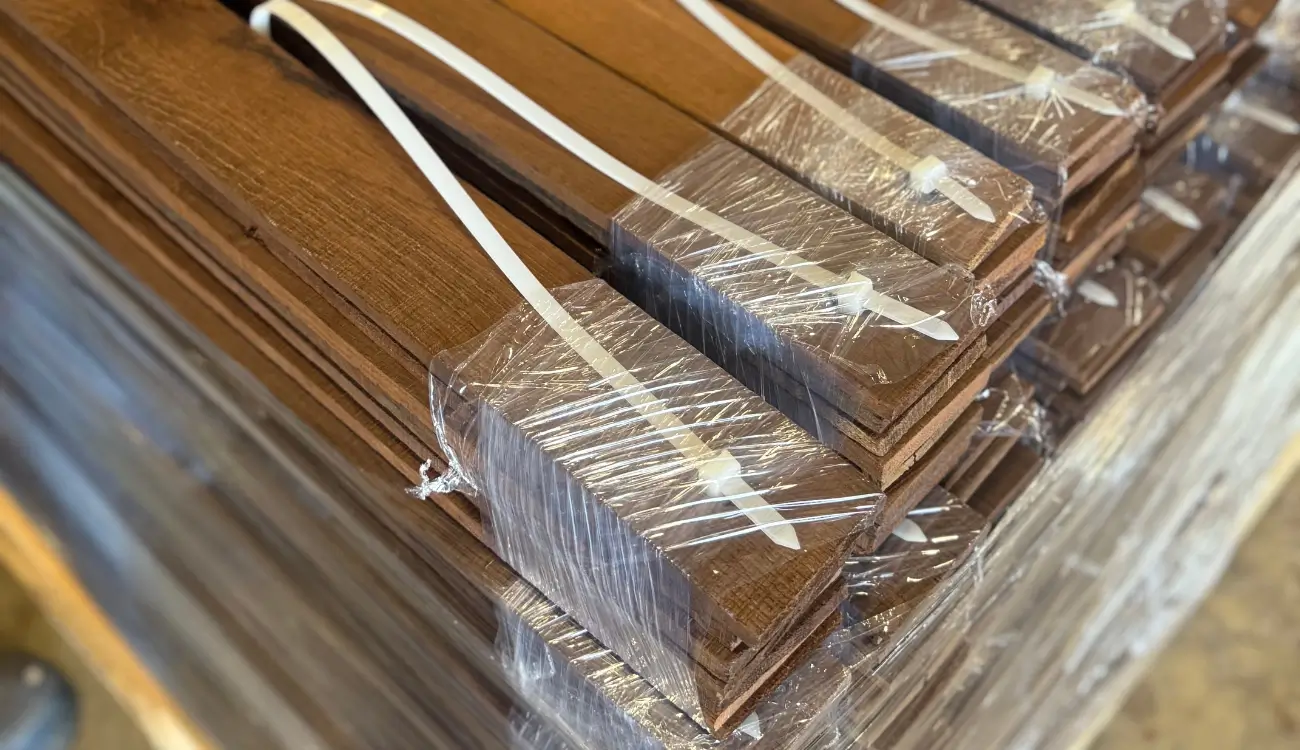
After seasoning, the wood is cut and processed into the specific formats that winemakers use: chips, cubes, staves, and powder. Each format is cut to dimensional specifications that determine surface area — and surface area determines extraction speed.
Chips: Cut to uniform small dimensions for maximum surface area and fast extraction. Inspected for dimensional consistency — oversized or undersized pieces produce inconsistent extraction.
Cubes: Cut to larger uniform dimensions — typically 10–20mm per side. Slower extraction than chips, more consistent contact geometry.
Staves: Long planks cut from seasoned stock to defined dimensions. Grain alignment maintained through the cut. Length and thickness specifications determine the surface area and micro-oxygenation characteristics of the finished product.
Powder: Ground to fine particle size for extremely fast extraction. Primarily for spirits and specialty applications.
Dimensional consistency within each format is a quality variable that directly affects extraction predictability. OCI's processing specifications maintain tight dimensional tolerances across all formats.
Step 6: Toasting
Toasting is the most visible step in the production chain — the transformation of raw, processed wood into the flavor-active product that changes wine. The toasting process, its chemistry, and how each toast level produces different compound profiles is covered in depth in the Oak Science pillar.
From a production chain perspective, the relevant quality considerations are:
Temperature precision
Toast level specifications — light, medium, medium plus, heavy — correspond to defined temperature ranges. Imprecise temperature control produces inconsistent compound profiles, even within the same labeled toast level.
Duration consistency
For a given temperature, duration determines how deeply the thermal transformation penetrates into the wood. Consistent duration produces consistent compound depth and therefore consistent extraction behavior in wine.
Batch-to-batch reproducibility
Premium oak alternative producers validate their toasting protocols against defined sensory and chemical benchmarks. OCI's toasting process is designed for batch-to-batch reproducibility — the medium toast French oak chips from this year's production perform the same as last year's.
Step 7: Inspection and Quality Control
Before any product is released for sale, OCI's quality management process includes:
Visual inspection
Dimensional consistency, absence of foreign material, uniformity of color consistent with labeled toast level.
Aromatic evaluation
Sensory evaluation of aroma profile against established benchmarks for each species, format, and toast level. Product that does not match the expected aromatic profile is rejected.
Moisture content verification
Moisture content is checked to confirm proper seasoning and to ensure packaging will not trap excess moisture that could promote mold during storage.
Lot documentation
Each production lot is assigned a lot number that provides full traceability back to sourcing origin, seasoning batch, processing date, and toasting run. This traceability is what allows OCI to investigate and resolve any quality concern a winemaker reports.
Adam Stanley, OCI's Quality Manager, oversees this inspection process. Quality management at OCI is not an administrative function — it is a production-critical role with authority to hold or reject product before it ships.
Step 8: Bagging and Shipping
Inspected product is packaged in sealed, moisture-resistant bags with full product specification labeling: species, format, toast level, lot number, and recommended storage conditions. Packaging is designed to protect product quality through the distribution chain and through reasonable storage periods at the winery.
Proper packaging prevents the two primary post-production quality risks:
- Moisture absorption during transit or storage
- Aromatic compound volatilization from prolonged exposure to air
OCI ships in packaging that maintains these protections under normal distribution and storage conditions.
Final Thoughts
The quality of an oak alternative is established long before it reaches a winery. Forest selection, harvesting practices, seasoning duration, processing precision, toasting control, and quality inspection all determine whether the product in the bag delivers consistent, predictable, high-quality results. OCI's fifty-year production history reflects a commitment to getting every step of that chain right — because the winemakers who depend on our products deserve to know exactly what they are putting in their wine.
Let our team choose the right oak for your winemaking or brewing project!
Reach out to our team or explore our wide selection of premium American and French oak barrel alternatives to enhance your beverages while also saving money compared to relying solely on traditional barrel aging!

by Brandon Haas
Published on 07/21/2026
Share Article
POPULAR POSTS
OAK ALTERNATIVES
How Long Should You Age Wine With Oak Chips?
NEWS/UPDATES
The Oak Scoop: May 2026
USING OAK IN WINEMAKING
What is Harvest and Why is it Important to Winemakers?
OAK SCIENCE
5 Ways To Make Your Alcohol Taste Better
by Brandon Haas
Published on 07/21/2026
Unsubscribe anytime. By entering your email, you agree to receive marketing emails from Oak Chips Inc. By proceeding, you agree to the Terms and Conditions and Privacy Policy.
POPULAR POSTS
OAK ALTERNATIVES
How Long Should You Age Wine With Oak Chips?
NEWS/UPDATES
The Oak Scoop: May 2026
USING OAK IN WINEMAKING
What is Harvest and Why is it Important to Winemakers?
OAK SCIENCE
5 Ways To Make Your Alcohol Taste Better